


Retaining Walls in Calgary
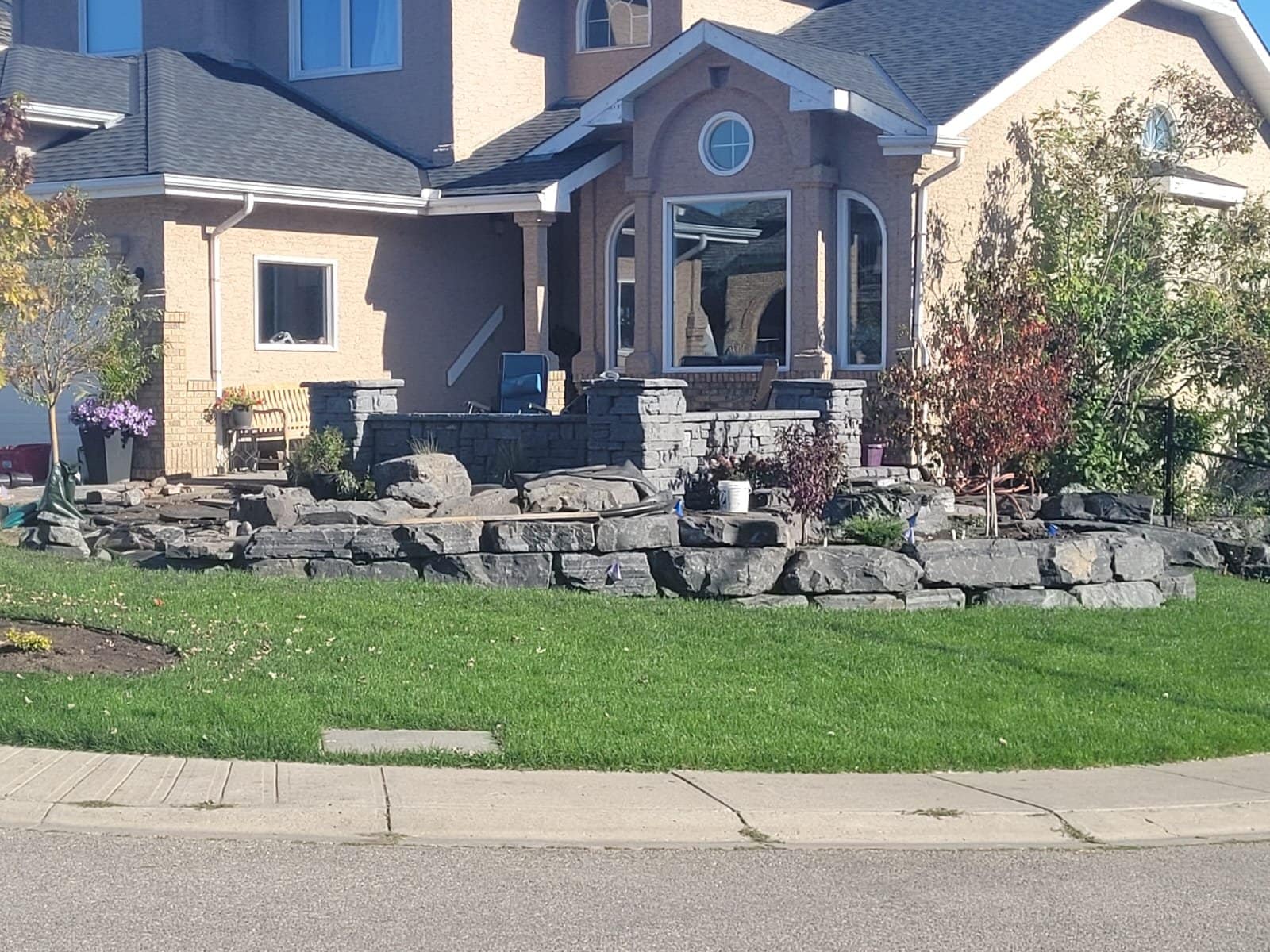
Thirty-five years of retaining wall installation in Calgary. Sungreen Landscaping has been at it since 1990, putting in interlocking block, natural stone, wood timber, and engineered concrete walls across every kind of freeze-thaw lot this market has. We are ICPI certified, and here is why that matters in practice. Most retaining wall failures around Calgary trace back to drainage, base preparation, and material spec rather than to anything on the visible wall surface. Skip the weeping tile or shortcut the granular backfill, and the wall leans within four winters no matter how clean the front face looked at handover.
Most homeowners reaching out about a retaining wall fall into one of three buckets: their lot slopes and needs terracing, they have an erosion problem to solve, or they want a level usable patch carved out of a grade change. Each scenario points at different material, height, and drainage choices. A 600-millimetre garden bed wall and an engineered 1.8-metre build holding back two metres of grade are not even close to the same project. Pricing reflects that difference too.
Both residential and commercial work fall within scope. Garden retaining walls on Bearspaw acreages. Multi-tier modular installations on Springbank lots. Commercial parking-lot retaining structures for business properties. Whatever the build looks like, our process is consistent: site visit, design, drainage planning, engineering when required, base preparation, wall installation, finished cap on top. Call 403-256-7500 to start a free estimate on your retaining wall project.
Retaining Wall Materials and Options
Material choice on a retaining wall depends on height, soil load, drainage conditions, and the aesthetic you want. Calgary’s freeze-thaw cycles drive every specification, since water held behind a wall freezes and expands, pushing the wall forward.
Modular Block Walls
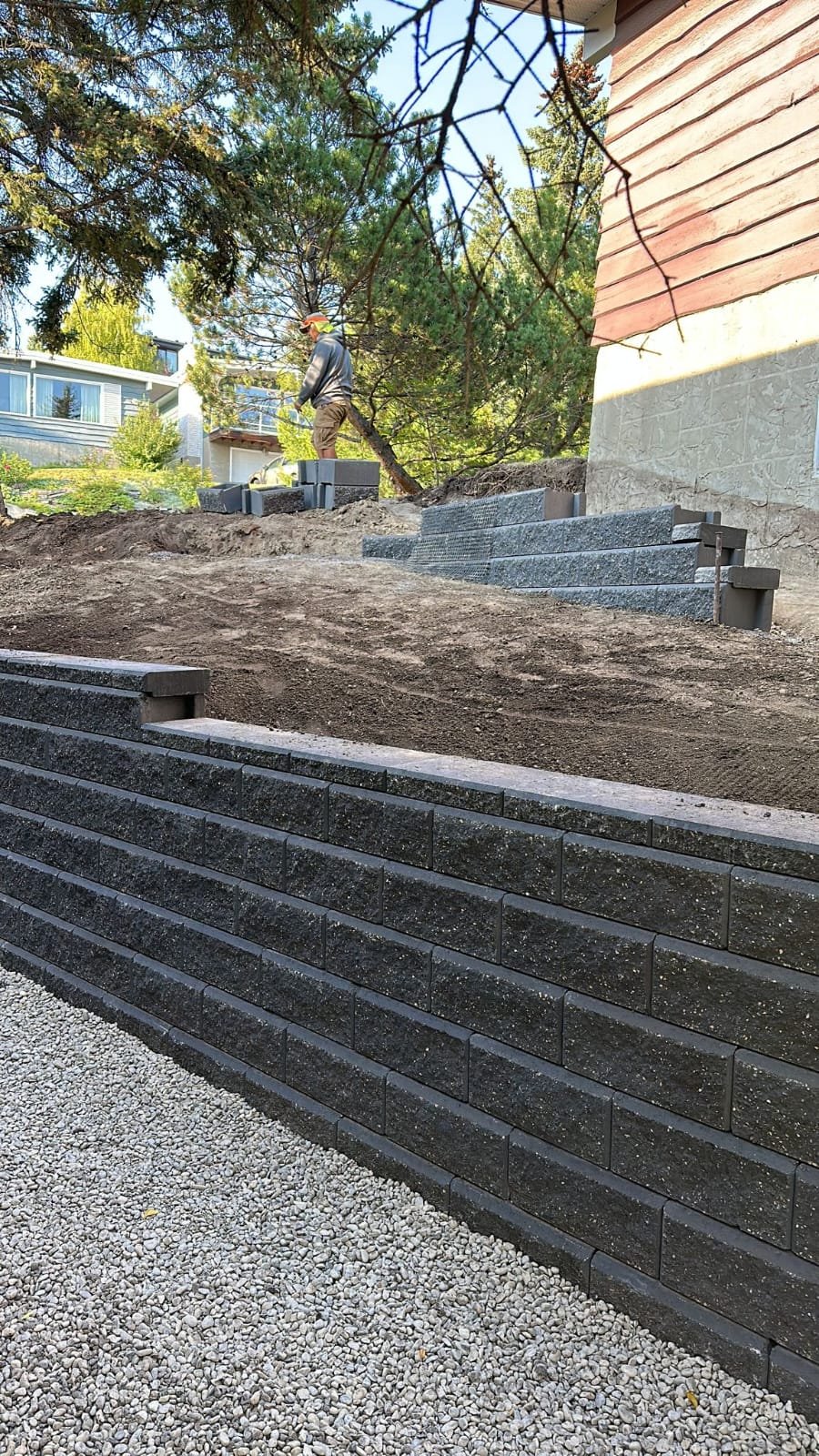
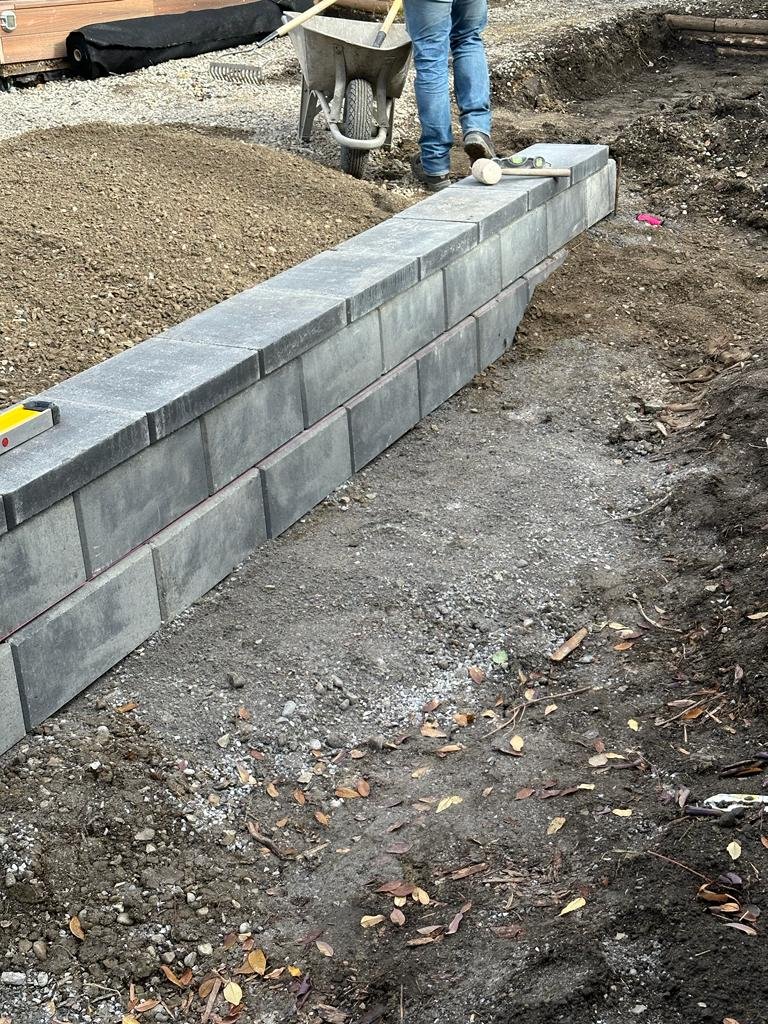
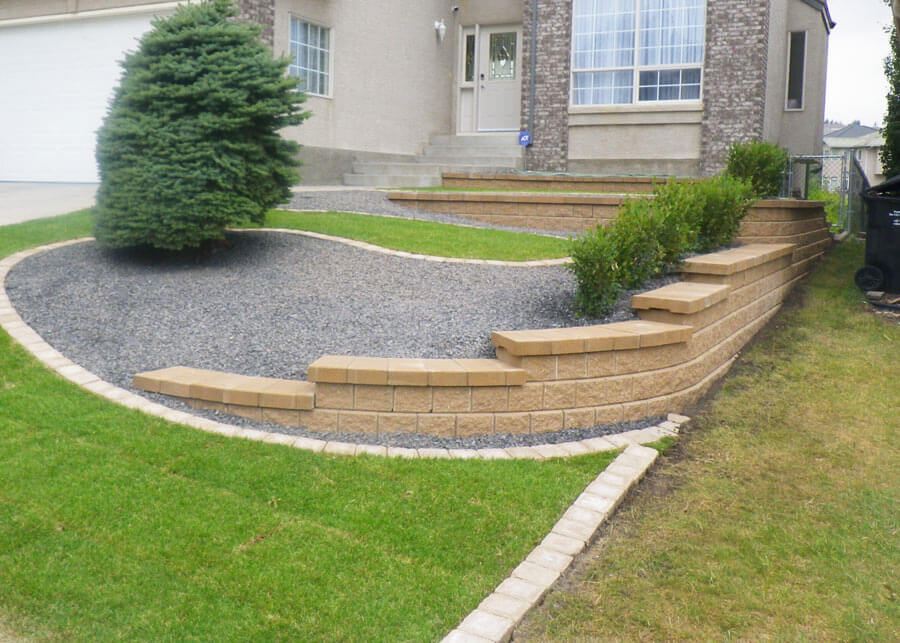
By a wide margin, modular block is the material we install most often on Calgary residential retaining walls. These modular block systems (sometimes called modular block walls) make up the bulk of our custom installs. Names you will hear most often: Belgard, Allan Block, Techo-Bloc, Barkman. They install quickly, handle this climate well, and come in dozens of colour and texture options. Each block interlocks with the next and leans back into the soil load slightly, which is where the structural stability comes from. Built right, the lifespan runs 25 to 50 years. Heights up to 1.2 metres work with interlocking block without engineering. Past that height the system needs engineered drawings, and often a geogrid reinforcement plan, to back the design.
Natural Stone and Boulder Walls
Hand-fitted granite, sandstone, or limestone blocks make up natural stone retaining walls. Boulder builds work with larger irregular stones, anywhere from 600 to 1200 millimetres across, placed by excavator rather than by hand. Both styles deliver an organic look that interlocking block cannot quite match. Cost runs higher because every stone gets individually fitted, and on the boulder side equipment access becomes a project requirement we work around on every site. The drainage performance is good. Joints allow water through naturally, better than mortared systems do. Lifespan on a properly built install lands somewhere between 50 and 100 years, which is essentially permanent in practical terms.
Wood Timber Walls
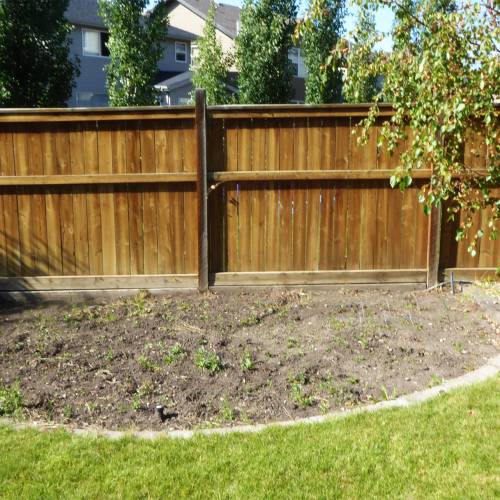
Pressure treated timber sits at the cheap end of the material range here. Cedar timbers cost more on the front side but resist rot longer in this climate. For garden retaining walls under 1.2 metres, wood works fine. Beyond that, masonry takes over because wood degrades faster than block under the same conditions. Pressure treated lumber will give you 20 to 30 years depending on how good the drainage was and how the soil holds up against the back face. Eventually the wood rots, particularly where it sits against wet soil. So timber suits budget-conscious garden bed projects, but for structural walls holding significant grade it is not the right pick.
Concrete Retaining Walls
For the heaviest loads and the tallest walls, cast-in-place concrete with steel reinforcement is the right tool. Most home applications only see cast concrete on engineered structures over 1.5 metres or on sites with poor soil bearing capacity. Industrial and commercial projects use it more often. Lifespan? Permanent, as long as the concrete mix and rebar placement match the engineering specification. Cost is the trade-off, and it runs the highest of any retaining wall option.
Why Drainage Makes or Breaks a Retaining Wall
Drainage drives retaining wall longevity more than any other variable. Here is the chain of events when drainage gets shortcut: ground behind the wall holds water, water freezes in winter and expands by 9 percent, that expansion creates hydrostatic pressure, the pressure pushes the wall forward, and the wall leans, tips, or fails. None of that depends on whether the block on the front is premium-grade or basic.
Four elements make drainage work on a Sungreen retaining build, and all four have to be in place from day one. The first is weeping tile, which sits at the base of the wall and runs sloped to daylight or to a drain outlet. Then comes the granular backfill (we use 19-millimetre clear crushed) filling at least 300 millimetres of horizontal depth behind the wall. A layer of geotextile fabric goes between that backfill and the native soil so the fines stay out of the drainage stone. Finally, surface drainage at the top of the wall directs runoff away from the wall face rather than over it.
We do not build a retaining structure without all four elements in place. Thirty-five years of repairing other contractors’ failures here has made that policy non-negotiable. The visible face is the last 10 percent of the work, and the hidden 90 percent decides whether the build lasts twenty years or two. Drainage engineering matters as much as the masonry on every project we put in.
Calgary Retaining Wall Permits and Engineering
The City of Calgary regulates retaining wall heights through the building code and zoning bylaws.
The basic rule: a retaining structure under 1.2 metres in height does not require a development permit. Builds between 1.2 metres and 1.5 metres require a development permit. Anything over 1.5 metres requires both a development permit and engineered drawings prepared by a licensed engineer. The height measurement applies to the exposed face of the wall from finished grade at the front, not from the top of the wall to the bottom of the buried base.
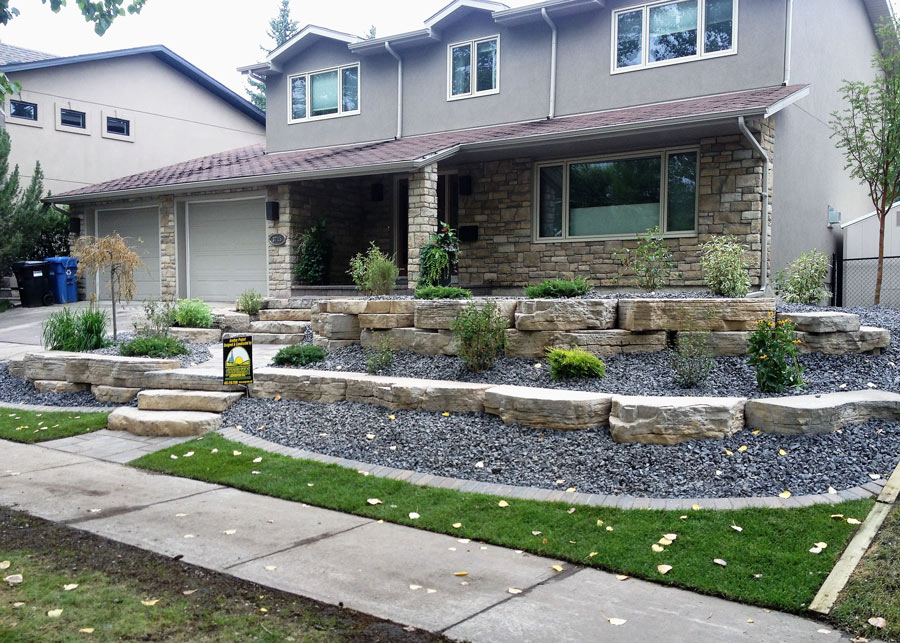
There is a useful trick on tiered builds. A two-wall system separated by a planting bench can sometimes stay under the engineering threshold, since the upper wall is not loading the lower one structurally. The bench has to be wide enough to make that real, and engineering practice here typically wants a 1:1 ratio between wall height and bench depth.
Sungreen handles the permit application when a project triggers one. Walls above the 1.5-metre threshold get engineer coordination on our end, and the engineered drawings go in as part of the application package. City turnaround on most residential retaining wall permits runs two to four weeks.
What Does a Retaining Wall Cost in Calgary?
Retaining wall pricing is calculated per square face foot installed. The face area is the exposed front of the wall (height multiplied by length), not including the buried base.
Walking through the pricing by material: timber walls are the cheap end of the range, $50 to $100 per square face foot installed. Modular concrete block lands in the $80 to $150 zone, with base preparation, drainage stone, geotextile, and finished cap all baked in. Natural stone runs higher (think $150 to $300 per square face foot) because every stone gets individually fitted. Boulder walls cost $100 to $250 depending on stone size and lot access. Cast concrete tops the ladder at $200 to $400 per square face foot when the project needs rebar-reinforced engineered structure.
For a real number, picture a 600-millimetre-high wall running 12 metres long. That works out to roughly 80 square face feet, which lands between $6,400 and $12,000 installed on interlocking block. Step up to a 1.5-metre by 15-metre wall (around 240 square face feet) and the same block system runs $19,200 to $36,000.
Engineering fees for walls over 1.5 metres run $1,500 to $4,000 depending on complexity and soil report requirements. Permit fees run a few hundred dollars. Both are separate from the construction cost. Our estimates are free and site-specific. No estimate gets issued without a site visit, since rocky soils, sloped access, or hidden utility lines on a lot can shift the price considerably between the first phone call and the actual proposal.
Calgary Retaining Wall Contractors: Our Process
Every project runs through the same sequence, residential or commercial.
Free estimate first. Site visit at your property, where we measure the area, check soil conditions, review drainage requirements, and talk through wall material preferences. No charge, no obligation attached.
Design comes next. 2D drawings cover wall layout, height, length, materials, and drainage details. For custom installations we also produce a 3D rendering.
Engineering steps in when the project needs it. Walls over 1.5 metres get coordinated with a licensed engineer for structural drawings.
Permit application follows when one is required. Drawings go to the city office, and we make sure authorization is in hand before excavation begins.
Excavation and base is the first physical phase: dig to required depth, install compacted granular base in lifts, place the geotextile fabric.
Wall installation comes after that. The crew lays blocks or stones with proper batter, installs weeping tile, places granular backfill in layers, and sets cap stones at the top.
Finishing wraps the build: backfill behind the wall, restore surrounding grade, install any topsoil and seed or sod for the surrounding area.
Handover is the last step. We walk through the build with the property owner. Workmanship warranty starts at that point.
Frequently Asked Questions
Do I need a permit for a retaining wall in Calgary?
A wall under 1.2 metres in height does not need a development permit. Heights between 1.2 and 1.5 metres do need one. Anything over 1.5 metres needs both a development permit and engineered drawings to back it. We handle the permit application on every project that triggers one.
How long does a retaining wall last?
Modular block builds last 25 to 50 years on a properly executed install. Natural stone runs longer, 50 to 100 years, basically permanent in practical terms. Wood timber lands at 20 to 30 years for pressure-treated lumber. Cast concrete is permanent when engineered correctly. The single biggest variable is drainage. A wall with poor drainage fails within a few years no matter how good the material was.
What is the best retaining wall material?
For most residential builds in Calgary, modular concrete block is the right pick. It handles this climate, installs quickly, comes in many colour options, and stays under the engineering threshold up to 1.2 metres in height. Natural stone is the better call on properties where the aesthetic justifies the cost premium. Wood is best reserved for short garden retaining walls on budget projects.
How long does retaining wall installation take?
Three to seven days for most residential interlocking block builds under 1.2 metres. Walls requiring engineering run longer because the drawing approval cycle adds time. Natural stone runs even longer due to fitting work, typically two to three weeks on residential. Commercial projects stretch out to three to six weeks depending on length and complexity.
What areas do you serve?
Calgary plus surrounding communities: Chestermere, Airdrie, De Winton, Cochrane, Okotoks, Bearspaw, Springbank, Langdon, Strathmore, and High River. Most retaining wall projects sit within 45 minutes of the city centre. Project complexity, access for equipment, and travel time all factor into estimates for properties on the far edge of that radius. Sungreen also handles decks, fences, paving stone patios, and landscape design on the same coordinated project. Call 403-256-7500 to confirm coverage on a specific address.
Have a question about retaining walls?
Please don’t hesitate to contact us at at 403-256-7500.


Why Choose Us? | A Passion for Landscaping
35+ Years of Experience
Almost Half a Century of Calgary Landscaping Expertise

